
 Africa
 Caribbean
 Australasia & Pacific
 Thailand
 India
 Cape Verde
 Kenya
Mounjaro Side Effects: What’s Common and What Needs Urgent Attention

Most people taking tirzepatide get some side effects, most of them are gut-related, and most settle. But “most” is not “all”, and there are a handful of symptoms that should send you to a doctor the same day rather than to a forum.
This guide is part of our complete guide to Mounjaro (tirzepatide).
In this guide
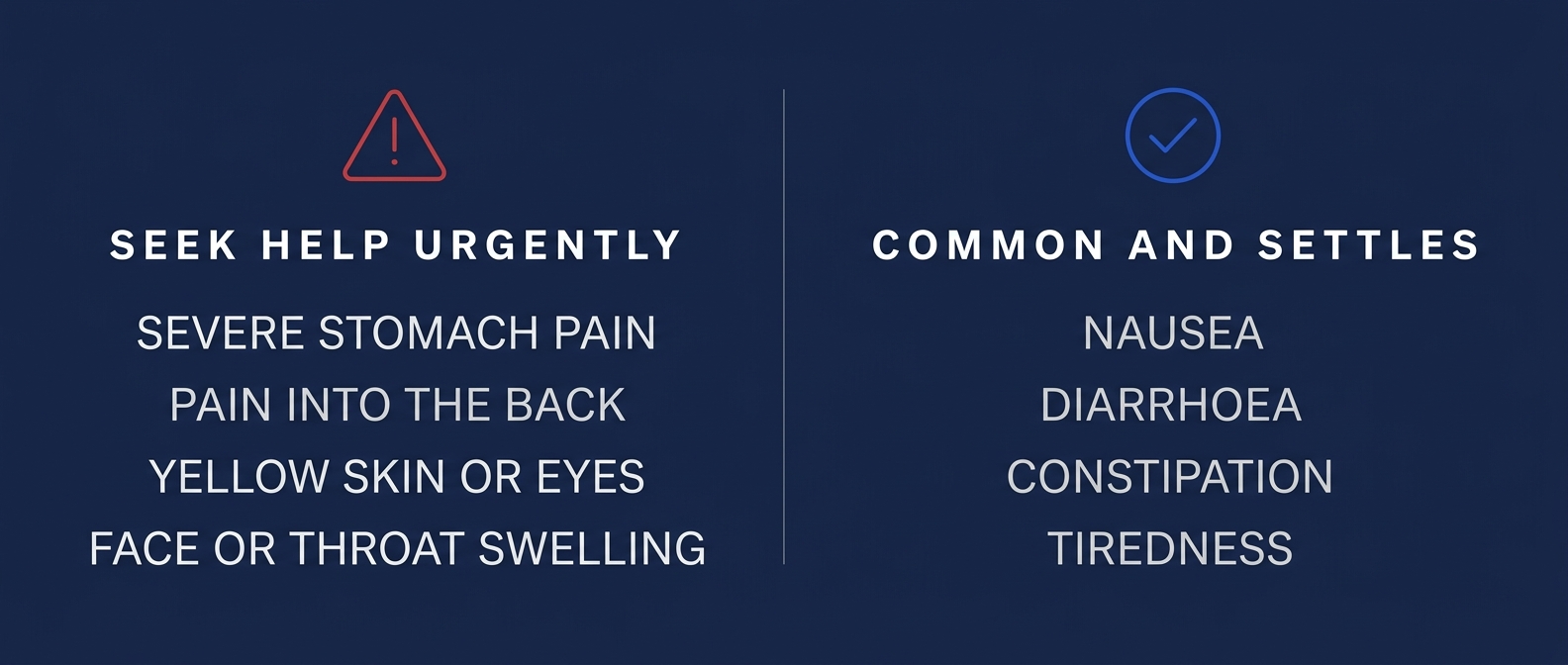
The red flags first
These come first deliberately, because they are the ones that matter most and they are usually buried at the bottom of other pages.
Signs of an allergic reaction: swelling of the face, lips, tongue or throat, difficulty breathing, or a widespread rash. Call 999.
Pain in the upper right abdomen, fever, or yellowing of the skin or eyes: possible gallbladder problems.
Vomiting or diarrhoea you cannot keep on top of: dehydration can affect the kidneys, and this is the most common route to serious harm.
The common ones
These affect a lot of people, and they cluster around starting treatment and around each dose increase. They usually ease within a few weeks as the body adjusts.
- Nausea: the most frequently reported, and usually the one that worries people into stopping
- Diarrhoea
- Vomiting
- Constipation
- Indigestion, reflux and burping
- Abdominal pain and bloating
- Reduced appetite: expected, since this is how the medicine works
- Fatigue, particularly early on
- Injection site reactions: redness, itching or a small lump
- Hair thinning: reported with significant weight loss generally, rather than being specific to this medicine
Why side effects spike after a dose increase
Worth understanding, because it changes how people respond to it. The dose schedule climbs in steps precisely so the gut can adapt. Each increase effectively restarts that adaptation, so a week of renewed nausea after going up a dose is common and does not mean something has gone wrong.
If symptoms are severe or not settling, the answer is often to stay at the current dose for longer rather than to push on or to stop altogether. That is a conversation to have with your prescriber, not a decision to make alone.
Managing the gut side effects
Practical things that help:
- Eat smaller portions, more slowly. Your stomach is emptying more slowly than it used to, and large meals sit heavily.
- Stop when you feel full rather than finishing the plate. Pushing past fullness is the most reliable way to trigger nausea.
- Go easy on fatty, fried and very rich food, which empties slowest of all.
- Keep drinking. Dehydration makes nausea worse and is the mechanism behind the more serious complications.
- For constipation: fluids, fibre and movement first; speak to us before adding anything else.
- Don’t skip meals entirely. Very low intake worsens fatigue and makes nutrition harder to maintain.
Things people often don’t realise
It can affect the contraceptive pill. Slowed stomach emptying can reduce absorption of oral contraceptives. A non-oral method or an added barrier method is advised for four weeks after starting and after each dose increase. → Mounjaro and contraception
Low blood sugar is a real risk for some people. Not usually for those on tirzepatide alone, but the risk rises considerably alongside insulin or a sulfonylurea. Those doses may need adjusting by whoever manages them.
Rapid weight loss carries its own risks: gallstones among them.
Alcohol tends to be less well tolerated, and it also irritates the stomach and adds calories without nutrition.
When to speak to us rather than wait
Contact the pharmacist who is managing your treatment if:
- Nausea or vomiting is stopping you eating or drinking normally
- Side effects are not settling after two to three weeks at the same dose
- You are considering stopping: there are usually better options than going it alone
- You start a new medicine, or another prescriber changes something
- You become pregnant or are planning to
Where to get reviewed in Hampshire
If side effects are troubling you, come and talk to us rather than stopping on your own. All four branches run weight management reviews, serving Havant, Emsworth, Rowlands Castle, Waterlooville, Bedhampton, Leigh Park, Portsmouth, Fareham, Petersfield and Chichester.
- Bosmere Pharmacy, Solent Road, Havant PO9 1DQ · 023 9248 1721 · open 7 days, until 9pm Mon–Sat
- Davies Pharmacy, 12 West Street, Havant PO9 1PF · 023 9248 3146
- Emsworth Pharmacy, West Street, Emsworth PO10 7DU · 01243 968 869
- Rowlands Castle Pharmacy, 14 The Green, Rowlands Castle PO9 6BN · 023 9241 3952
Read more
- Mounjaro (tirzepatide): the complete patient guide
- Am I eligible? BMI and criteria explained
- Mounjaro and contraception
- Starting Mounjaro: your first month
Frequently asked questions
What are the most common Mounjaro side effects?
Nausea, diarrhoea, vomiting, constipation, indigestion, reduced appetite and tiredness: mostly around starting and after dose increases.
How long do side effects last?
Usually days to a few weeks, easing as the body adapts. Each dose increase can bring a short return.
When should I worry?
Severe abdominal pain spreading to the back, signs of an allergic reaction, yellowing of the skin or eyes, or vomiting and diarrhoea you cannot control. Seek medical help urgently.
Can I do anything about the nausea?
Smaller and slower meals, stopping when full, avoiding rich or fatty food, and keeping fluids up all help. Staying longer at your current dose is often better than pushing upward.
Does it interact with the pill?
It can reduce absorption of oral contraceptives. Use a non-oral or additional barrier method for four weeks after starting and after each increase.
Should I stop if I feel sick?
Speak to your prescriber first. Adjusting the dose or pausing an increase is often more appropriate than stopping outright.
Does it cause hair loss?
Thinning is reported with substantial weight loss in general rather than being specific to this medicine, and it is usually temporary.
General information reflecting the UK licensed use of tirzepatide. Not personalised medical advice and not a substitute for the patient information leaflet. If you feel seriously unwell, seek urgent medical attention, or call 999 in an emergency.

Southdowns Pharmacy Group
Part of the GPhC-registered pharmacy team at Southdowns Pharmacy, providing evidence-based health guidance across our Hampshire branches.