
 Africa
  Caribbean
  Australasia & Pacific
  Thailand
  India
India  Cape Verde
  Kenya
Kenya Vitamin B12 Deficiency: The Complete Guide

Vitamin B12 is one of the few nutrients your body genuinely cannot manufacture, cannot easily replace, and cannot function without. It builds your red blood cells, protects your nerves, releases energy from food and supports your brain. Run short of it and the effects show up almost everywhere — which is exactly why deficiency is so often mistaken for something else.
This guide brings together everything worth knowing: what deficiency feels like, what causes it, why blood tests can be misleading, and what the treatment options actually are. Southdowns Pharmacy Group provides vitamin B12 injections at our Bosmere, Davies and Emsworth branches, with no GP referral needed.
What vitamin B12 actually does
Four jobs, and each one explains a different set of symptoms.
- Builds healthy red blood cells. Short of B12, cells form abnormally large and carry oxygen poorly — which is why deficiency causes breathlessness and exhaustion.
- Maintains your nervous system. B12 is needed for myelin, the protective sheath around your nerves. This is why deficiency causes tingling, numbness and balance problems.
- Releases energy from food. It is essential to the metabolic pathways that convert what you eat into usable energy.
- Supports brain function and mood. Including processing homocysteine, and it works hand in hand with folate.
Your liver stores several years’ worth, which is why deficiency creeps up slowly rather than arriving suddenly — and why people often cannot pinpoint when they started feeling different.
The symptoms
They divide into two groups, and the second group is the one that matters most.
Blood-related: persistent fatigue, breathlessness on exertion, palpitations, pale or slightly yellow-tinged skin, dizziness, headaches.
Nerve and brain-related: tingling or numbness in the hands and feet, brain fog, memory lapses, poor concentration, low mood or irritability, unsteadiness, a sore or smooth tongue, mouth ulcers.
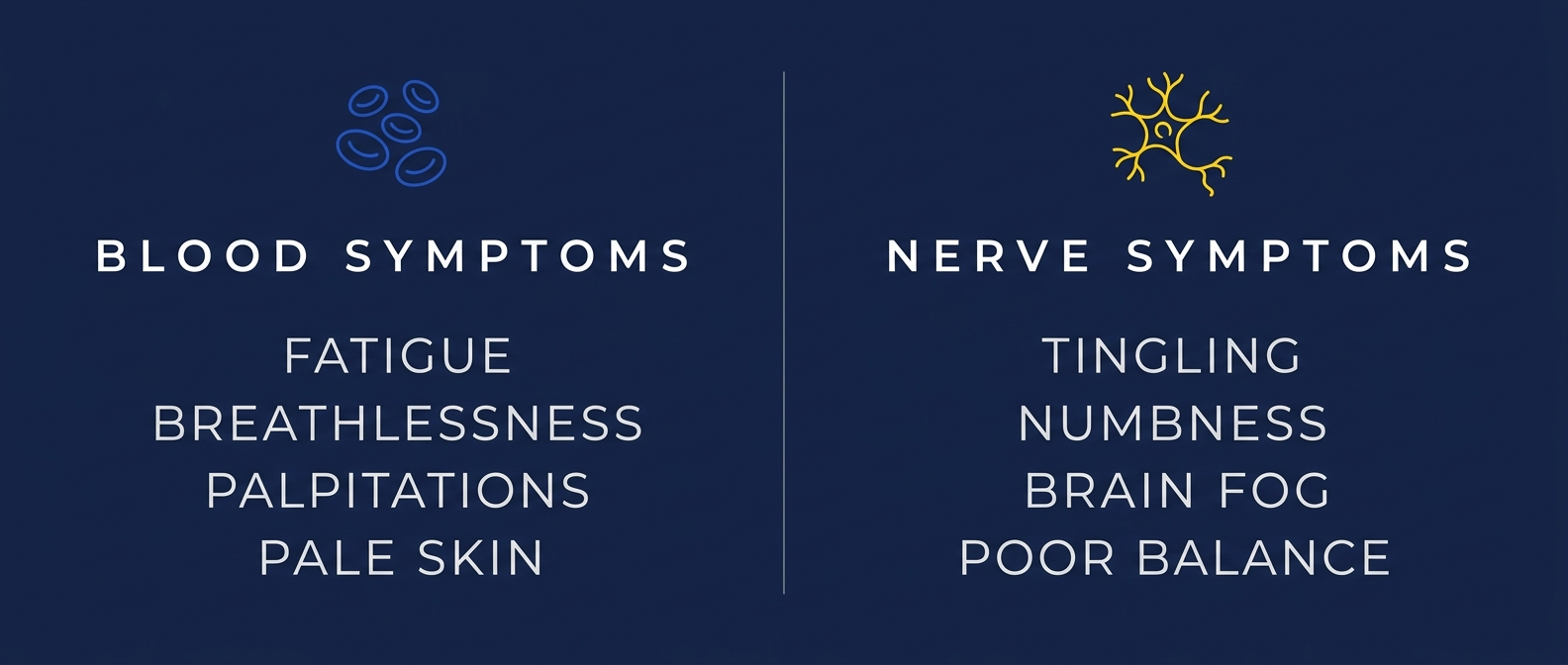
The neurological symptoms deserve particular attention. They indicate the deficiency is already affecting your nervous system, and while they usually improve with treatment, prolonged deficiency can cause lasting damage. That is why tingling and numbness are not symptoms to monitor and hope about.
→ B12 deficiency symptoms in women, and why they are so often attributed to perimenopause or thyroid problems.
What causes it
Most people assume diet. In practice, absorption is the more common culprit — you are eating enough B12 and your body is not taking it in. Absorption requires stomach acid, a protein called intrinsic factor, and a healthy section of small intestine. Disrupt any of the three and levels fall regardless of what you eat.
- Autoimmune gastritis and pernicious anaemia — the immune system attacks the cells producing intrinsic factor
- Long-term medicines — metformin, proton pump inhibitors, H2-receptor antagonists, and medicines for epilepsy, anxiety, nerve pain or gout
- Diet — vegan and vegetarian eating without supplementation or fortified foods
- Age — stomach acid declines, so absorption becomes less efficient over 50
- Gut conditions and surgery — coeliac disease, Crohn’s, gastric or bariatric surgery, bowel resection
- Pregnancy and breastfeeding — requirements rise
- Nitrous oxide use — interferes with how B12 works in the body
→ The full guide to what causes B12 deficiency, including which medicines to watch.
Why a “normal” blood test doesn’t always settle it
This is the single most useful thing to understand. A standard test measures total serum B12, most of which is not actually available to your cells. In the earlier stages of depletion, your total can sit comfortably inside the reference range while your tissues are already running short.
Two further points. Laboratory reference ranges vary, so the range printed on your own report is the one that counts. And NICE notes that people of Black ethnicity may have a higher reference range for serum B12 than people of White or Asian ethnicity — rarely mentioned, but clinically relevant. Where results are indeterminate and symptoms persist, NICE’s 2024 guidance suggests further testing such as MMA can help clarify the picture.
→ The 4 stages of B12 deficiency — why the standard test only reliably detects the later ones.
Treatment: injections, tablets, or diet
Which is right depends entirely on the cause.
- Dietary deficiency with a healthy gut — oral supplementation or dietary change is usually sufficient, and is the sensible first step.
- Absorption problems — injections bypass the gut entirely, which is why they are the established treatment where absorption is the issue.
- Pernicious anaemia — NICE recommends hydroxocobalamin injections, and treatment is lifelong, typically 1mg every two to three months, continued even once symptoms resolve.
→ B12 injections vs tablets — the full comparison, and when injections are genuinely necessary.
What improves, and how quickly
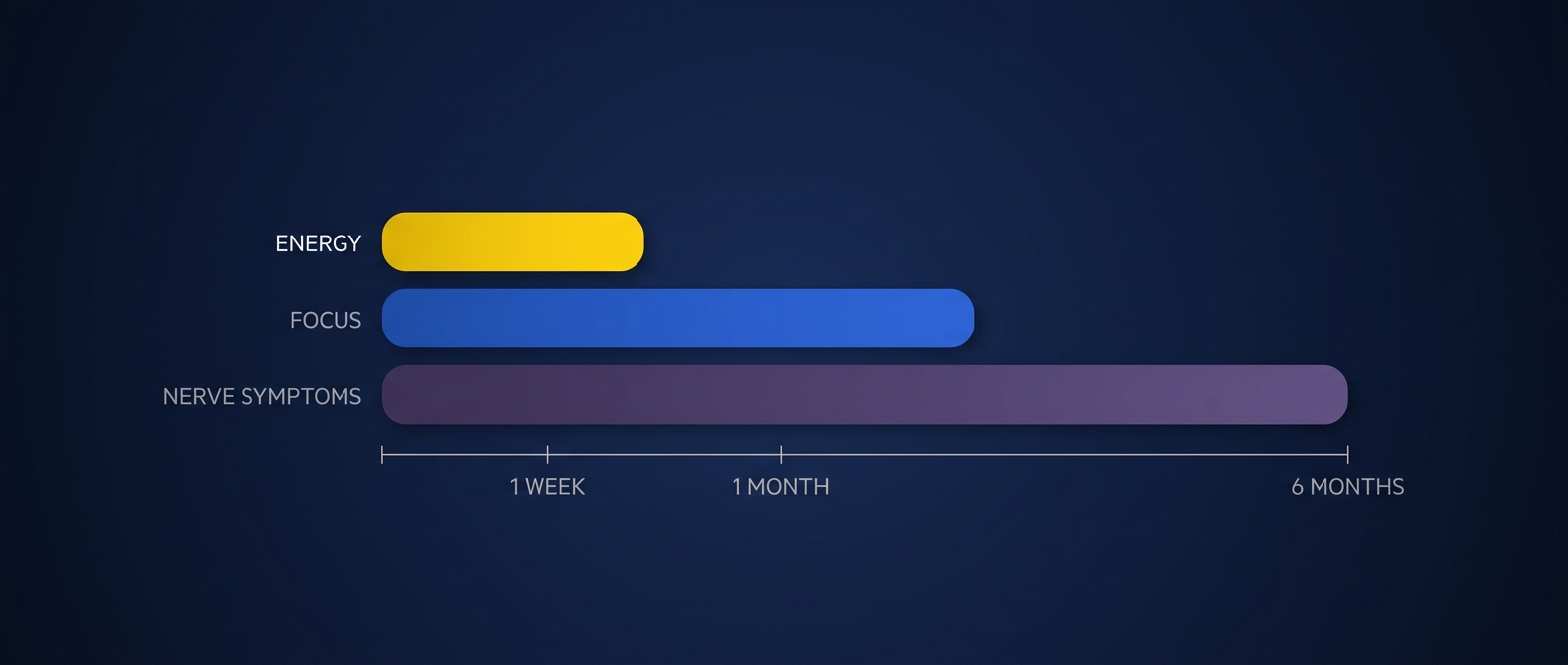
- Days to two weeks — energy and general wellbeing usually lift first
- Two to eight weeks — brain fog, concentration and mood improve more gradually
- One to two months — blood counts normalise
- Months — tingling and numbness are slowest, and improvement can continue for a long time
The honest caveat: this applies if you are genuinely low. Topping up B12 when your levels are already healthy will not give you more energy.
B12 injections at Southdowns Pharmacy
We provide vitamin B12 injections at Bosmere Pharmacy (Havant), Davies Pharmacy (Havant) and Emsworth Pharmacy. No GP referral, no waiting list, and appointments take around ten minutes.

Our pharmacists will consider an injection where there is confirmed deficiency, an absorption problem, a diet low in B12, use of medicines associated with lower B12, or nitrous oxide use. If pernicious anaemia or another absorption disorder is likely, you need a formal diagnosis and the NHS lifelong regimen through your GP — and we will tell you so plainly.
Read more on vitamin B12
- B12 deficiency symptoms in women
- The 4 stages of B12 deficiency
- What causes B12 deficiency
- B12 injections vs tablets
- Why am I always tired? Other causes worth checking
Frequently asked questions
What are the first signs of B12 deficiency?
Usually fatigue and brain fog, often with tingling in the hands or feet, mood changes or a sore tongue. Symptoms build gradually.
Can I have B12 deficiency with a normal blood test?
Yes. Total serum B12 can sit within the reference range in the earlier stages while the amount reaching your cells is already low.
How long does B12 deficiency take to correct?
Energy often lifts within one to two weeks, brain fog over several weeks, and nerve symptoms over months.
Do I need injections or will tablets do?
It depends on the cause. Dietary deficiency often responds to tablets; absorption problems generally need injections.
Where can I get a B12 injection in Hampshire?
At our Bosmere, Davies and Emsworth branches, with no GP referral needed.
Can B12 deficiency be permanent?
The deficiency itself is treatable, but prolonged neurological involvement can cause lasting damage — which is why early action matters.
This guide is general information and not a diagnosis or a substitute for advice from your GP. If you are pregnant or breastfeeding, or you have numbness, tingling or balance problems, please seek medical advice rather than self-treating.

pharmodigital2026
Part of the GPhC-registered pharmacy team at Southdowns Pharmacy, providing evidence-based health guidance across our Hampshire branches.