 Africa
  Caribbean
  Australasia & Pacific
  Thailand
  India
India  Cape Verde
  Kenya
Kenya Understanding Your Blood Test Results: A Simple UK Guide

Blood test results can be genuinely baffling. A page of abbreviations, numbers and reference ranges, often with no explanation of what any of it means for you. This guide breaks down the most common blood tests in plain English, so you can walk into a conversation about your health already understanding the basics.
If you would rather skip straight to booking, you can see the full range of private blood tests in Hampshire we offer at our Davies Pharmacy phlebotomy centre in Havant, with results in 24 to 48 hours and a pharmacist to talk you through them.
First, an important point about reference ranges
Every result you receive is compared against a reference range, which is the span of values considered normal for most healthy people. Two things are worth knowing:
- Ranges vary between laboratories. Different labs use different equipment and methods, so the range printed on your report is the one that matters, not a figure you found online.
- Ranges vary between people. Age, sex, pregnancy, ethnicity, medication and even how recently you ate can all shift a result. A number slightly outside a range is not automatically a problem, and a number inside it does not always mean all is well.
This is exactly why interpretation matters more than the number itself, and why every test we carry out includes a consultation with a GPhC-registered pharmacist rather than just a printout.
The blood tests we offer, explained
Cholesterol and lipids
A lipid profile measures the fats in your blood that influence your risk of heart disease and stroke: total cholesterol, LDL (often called “bad” cholesterol), HDL (“good” cholesterol), and triglycerides. Rather than one headline number, it is the balance between them that tells the story.
→ Read our full guide to cholesterol levels and what a normal range looks like
Thyroid function
Thyroid tests usually start with TSH, the hormone that signals your thyroid to work, sometimes alongside T4, T3 and thyroid antibodies. Together they show whether your thyroid is underactive, overactive, or working normally, which matters because thyroid problems are a common and very treatable cause of fatigue.
→ Read our guide to TSH and thyroid test results
Full blood count
An FBC counts the different cells in your blood: red cells and haemoglobin, white cells, and platelets. It is one of the broadest general health checks available and often the first test used to investigate tiredness, frequent infections or suspected anaemia.
→ Read our guide to full blood count results
Blood sugar and type 2 diabetes
Diabetes screening looks at your blood sugar to gauge your risk of type 2 diabetes. Because raised blood sugar often causes no symptoms for years, screening is one of the most useful early checks available, and risk can frequently be reduced once you know where you stand.
→ Read our guide to diabetes blood test results

What an abnormal result actually means
Seeing a result flagged as high or low is unsettling, but it is rarely the whole picture. An out-of-range value can be caused by something as ordinary as a recent illness, a heavy workout, dehydration, a supplement you are taking, or not having fasted when you should have. It can also be a genuine early signal worth acting on, which is the point of testing.
What matters is context: your other results, your symptoms, your history and, often, a repeat test. That interpretation is the part that turns numbers into something useful.
Pharmacy test or postal kit? What actually differs
Home blood test kits are widely advertised and often cheaper, so it is a fair question. The differences that matter are these.
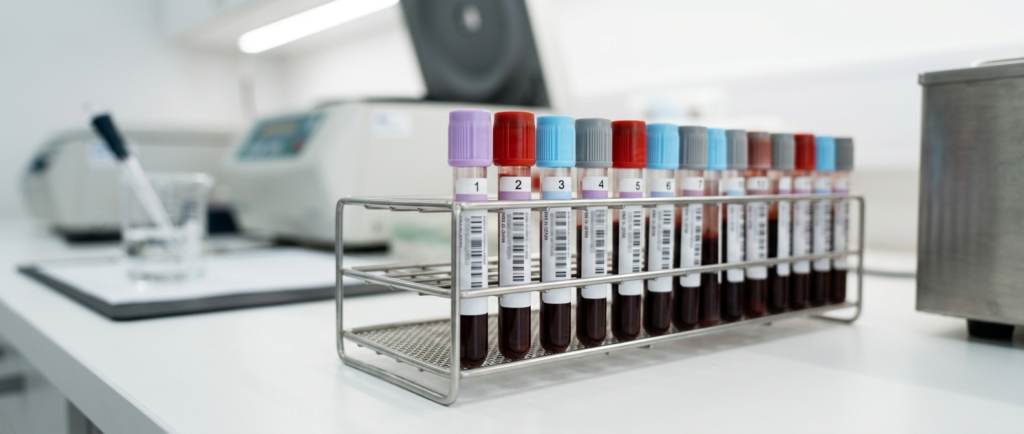
- Who takes the sample. A postal kit relies on you pricking your own finger and filling the tube correctly. With us, a trained member of our team takes a proper venous sample, which reduces the risk of a clotted, insufficient or contaminated sample being rejected by the lab.
- Sample quality and repeats. Rejected samples are one of the most common frustrations with home kits, and they mean starting again and waiting longer.
- Who explains the result. A postal kit typically sends a PDF. Ours includes a consultation with a GPhC-registered pharmacist who talks you through the numbers, in context, and tells you honestly whether it warrants a GP conversation.
- What the price includes. Our fee covers the appointment, the sample, the laboratory analysis and that consultation — not just a kit in the post.
If you simply want a number, a kit may suit you. If you want the number and to understand what it means, that is what we are set up for.
How to get tested in Hampshire
You do not need a GP referral for private testing. At Southdowns Pharmacy, blood tests are carried out at our dedicated phlebotomy centre at Davies Pharmacy in Havant, with results typically back within 24 to 48 hours and a pharmacist consultation included to explain them.
Frequently asked questions
Can I get a blood test without seeing a GP?
Yes. Private blood tests can be booked directly, with no referral and no waiting list.
How long do results take?
At Southdowns Pharmacy, results are typically available within 24 to 48 hours.
Do I need to fast?
It depends on the test. Some lipid tests ask you to fast; most others do not. We confirm any preparation when you book.
Will someone explain my results?
Yes. A pharmacist consultation is included with every test, so you understand what your results mean and what to do next.
What if a result is abnormal?
Your pharmacist will put it in context, explain what it may indicate, and advise clearly if it is worth speaking to your GP.
This guide is general information and not a diagnosis or a substitute for advice from your GP. Reference ranges vary between laboratories and individuals. If you have urgent or serious health concerns, please contact your GP or NHS 111.

pharmodigital2026
Part of the GPhC-registered pharmacy team at Southdowns Pharmacy, providing evidence-based health guidance across our Hampshire branches.